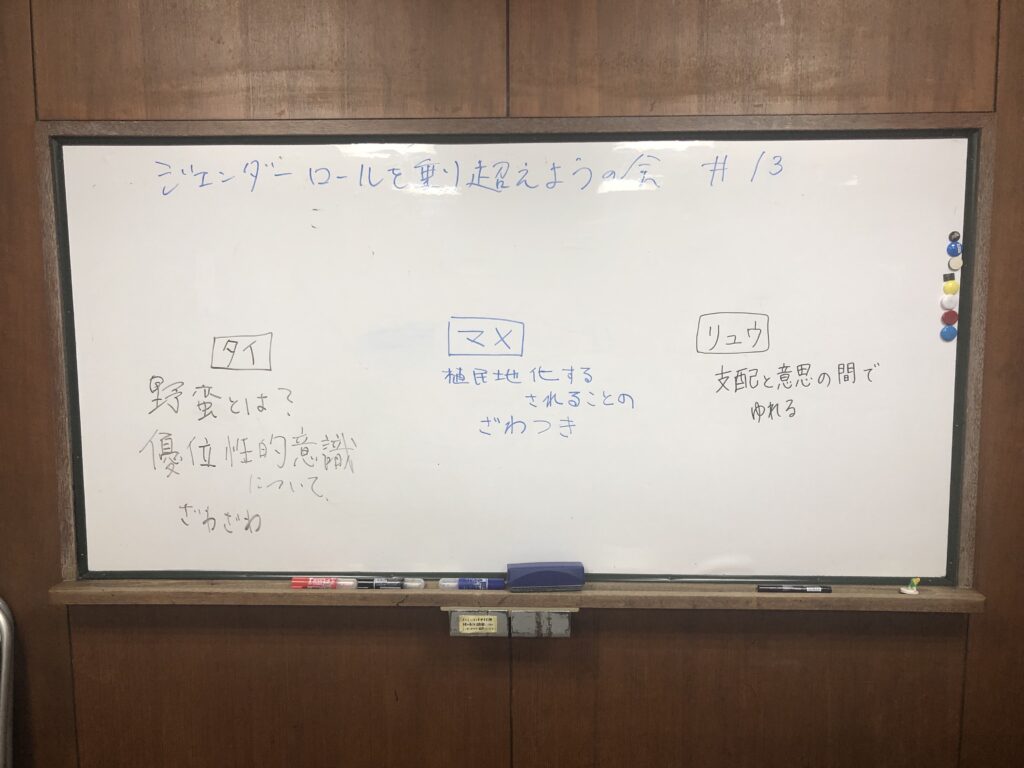
Session 13
Sunday, August 31, 2025
Participants: 3
Study Group on Beyond Gender Roles
"Colonial Rule and Gender"
In this thirteenth session of the Study Group on Beyond Gender Roles, participants read Chapter 7, “Deconstructing Gender in Western Modernity — Global History,” from An Introduction to Western Gender History: From Family History to Global History by Naoko Yuge.
を読みました。
Through examining the history of colonial rule that developed after the Age of Exploration, the group learned about how gender has been positioned and constructed within colonial contexts, and exchanged a wide range of views.
Sati and Kamikaze Units — Martyrdom and Superiority
The discussion began with the practice of sati, widow immolation in India. Sati, in which a wife was expected to die by suicide following her husband’s death, has been regarded as an honor for those involved, yet was also described as deeply disturbing and violent when viewed from the outside. One participant suggested that Japan’s kamikaze units may share a similar underlying structure.
Acts of martyrdom that are treated as “natural” or self-evident are often framed as noble and sublime. At the same time, participants expressed the view that women’s rights are threatened in cases such as sati, where women are deprived of the freedom to choose life over death.
The discussion expanded to include the role of education in instilling particular values, as well as the imposition of a sense of cultural superiority by colonizing powers. While debates around sati often focus on women’s rights, participants also raised the question of where the problem begins when Western culture is imposed on colonized societies as inherently superior.
The group also discussed historical cases in which Aboriginal children were taken away from their parents and subjected to Western-style education under colonial rule. It was noted that boys born in the colonies to families of the ruling power were often considered unable to become “proper adults” without receiving education in the colonizing country, and were therefore sent back to the metropole. Participants then raised the question of how girls in the same position were treated.
Desire, Discipline, and Gender
The discussion then shifted to the relationship between desire and discipline within colonial rule.
Participants spoke about a recurring pattern in which men first ventured into colonies to explore and dominate them, followed later by women. While some women fell in love with Indigenous people, colonizing men feared such relationships and went so far as to create laws that allowed for the execution of Indigenous men on charges of raping colonizing women. Participants pointed out the danger inherent in individual desires being transformed into systems of discipline and institutional control.
The practice known as the “sleeping dictionary,” in which relationships with Indigenous women were used as a means of acquiring local knowledge, was also introduced. Although this practice was treated as part of colonial strategy, participants voiced discomfort with the structure by which desire was legitimized and justified through imposed rules and discipline. The question was raised as to whether male rationality truly cannot be maintained without such disciplinary frameworks.
It was further shared that the deployment of white women to colonies functioned as a means of restraining the behavior of men. Participants noted that even today, there may be a deeply rooted belief that “men become unruly when left only with other men,” and questioned whether this, too, constitutes a form of gender bias.
Gender as a Political Strategy
The discussion broadened from colonial issues to contemporary politics. In Japan, where the Gender Gap Index remains low, men still make up the majority of political leaders.
Within this context, the tactic known as the “honey trap,” in which relationships with women are used to gain leverage over politicians, was introduced. Participants questioned whether this strategy would be equally effective if applied to female politicians.
Alongside sharing the reality that gender is embedded in political strategies and power negotiations, participants also questioned the assumptions and validity underlying such narratives.
Reconsidering Success Stories, Tradition, and Religion
In the final part of the discussion, participants exchanged views on the relationship between gender, tradition, and religion.
An example from Miyakejima was introduced, where a shortage of male carriers for a traditional festival shrine led to women taking on the role of carrying the portable shrine. This adaptation was described as a way of preserving tradition itself. Participants observed a paradoxical structure in which rethinking gender norms has, in fact, enabled the continuation of tradition.
The discussion also extended to gender norms embedded in religious rituals and missionary paintings. In India, spinning thread has historically been regarded as a form of spiritual discipline performed by men. However, from a Western perspective—where spinning is commonly seen as women’s work—this practice may appear unfamiliar or unsettling. One participant shared a personal experience of seeing men sewing with machines facing outward toward the street in India, and feeling a similar sense of surprise.
Notes: Danshiro
References:
"A Beginner’s Guide to Western Gender History"
Written by Naoko Yuge
Chapter 7, “Deconstructing Gender in Western Modernity — Global History,”
This book is a valuable introduction to how gender has been constructed across Western history, offering insight into how these ideas can be deconstructed and reimagined today.
Past posts
- Why the Trouble?
- Matrilineal Society, Instinct, and Gender
- Perspectives on Marriage in Japan
- Future References
- Gender Roles Considered from Article 24 of the Constitution
- Colonial Rule and Gender
- Military History and Gender
- Expanding the Range of Masculinity
- Body Image Through the Lens of Body History
- How History Shaped Our Ideas of Gender
- Gender Representation from the Perspective of Women’s History
- Exploring the Family of the Future through Family History
- Body, Feminism, and Porn
- Nation and Gender
- Choices in Labor, Sex Education, and Gender
- On Postmodern Families and Gender
- On Diversifying Families and Children's Rights
- Gender Roles in Parenting