Sunday, December 28, 2025
Participants: 6
Study Group on Beyond Gender Roles — Session 17
“Matrilineal Society, Instinct, and Gender”
In this seventeenth session of the Study Group on Beyond Gender Roles, participants read Chapter 4, “The Reality of Fatherhood,” and Chapter 5, “Insights from Animals That Do Not Need Males,” from Men as Lonely Beings by Toshiaki Kitsuki, and exchanged views based on the readings.
During the discussion, multiple participants expressed a sense of discomfort with certain expressions used by the author, and each shared their own thoughts and feelings in response.
What Is a Matrilineal Society? — In Comparison with Patrilineal Inheritance and Subordination
In particular, the author’s phrase “fear of the revival of matrilineal society” became a starting point for discussion. Participants talked about why the author himself might feel anxiety toward matrilineal societies, and who the book is written for. One view that emerged was that the book may be aimed primarily at men of the author’s own generation, especially those who share a similar fear of the revival of matrilineal society.
As an example of a matrilineal system, Judaism—where lineage is inherited through the mother—was discussed. In patrilineal societies, there has historically been a tendency to celebrate the birth of a son as the one who will carry on the family line. In contrast, participants raised the question of how the birth of a daughter has been understood and valued within a matrilineal context such as Judaism.
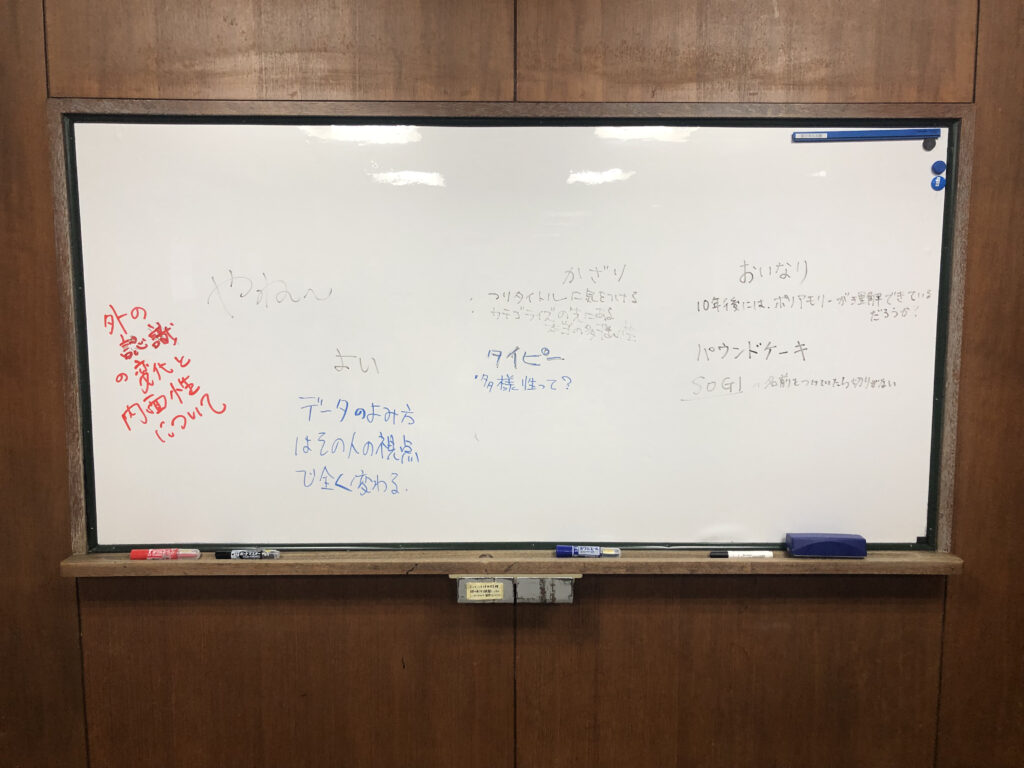
Participants also pointed out that statements such as “women desire childbirth” may reflect the author’s own fixed and stereotypical image of women. While the group was able to confirm and compare different ways of reading the statistical data presented in the book, attention was drawn to the author’s reaction to a bar graph on violence between men and women, where he expresses surprise that men can also be victims. This led to a renewed awareness that the interpretation of data is greatly influenced by the reader’s values and assumptions.
Regarding the fact that separate surnames for married couples are not permitted in Japan, participants living overseas shared that people are often surprised by this. An example from Spain was also introduced, where children can choose either parent’s surname. Through these examples, participants confirmed that ideas about family and what is considered “normal” vary greatly depending on cultural context. Using the example of the Nair people, who are discussed in the book and traditionally do not have fathers within the family structure, the discussion expanded to questions of what constitutes a family, who owns what, and how ideas of ownership and exclusivity operate. This, in turn, led to discussion of polyamory as one possible form of family.
How Should Unpaid Labor Be Understood?
The discussion then moved to the topic of unpaid labor. Some participants expressed discomfort with the very act of labeling housework and childcare as “unpaid labor,” suggesting that people are not living for the sake of labor, but rather living their lives, of which these activities are a part.
Participants questioned why eating a meal is not considered unpaid labor, while cooking a meal is. Cooking, too, is something done in order to live, and may not necessarily need to be categorized as labor. The discussion extended to whether acts such as putting on makeup, getting ready, or hosting others should be considered labor, and where the boundary comes from that defines certain activities as “unpaid labor.”
It was also suggested that there may be a structure in which people engaged in paid labor unconsciously come to view those who perform unpaid labor as having lower value. While the term “unpaid labor” has been used in order to recognize and assign value to such activities, participants also expressed discomfort with the way housework and care work are thereby absorbed into the framework of labor.
Another topic raised was the difference in how cooking is evaluated depending on gender: when men cook, it is often praised as a hobby or special skill, whereas a housewife’s cooking is treated as unpaid labor. Participants also discussed the existence of gender-labeled spaces such as “men’s cooking classes” or “women’s DIY workshops.” While these spaces can function as accessible places that reduce psychological barriers to participation, they were also noted as potentially reinforcing fixed gender images.
On Understanding Diversity Through Biology
Regarding narratives that explain male aggression through the idea of sperm competing to reach a single egg—so-called “sperm competition” (Baker’s concept)—participants shared doubts about whether such explanations are convincing, given that both men and women are born through the same process. While concepts such as sperm competition, peacock courtship behavior, and comparisons between primates and humans may appear simple and persuasive, participants questioned whether it is appropriate to apply these biological explanations directly to human society.
The sexual behaviors of bonobos and chimpanzees were also discussed, particularly in terms of how they are interpreted and from whose perspective. Some participants expressed discomfort with the tendency to accept explanations simply because they are framed as “biological.”
One interpretation suggested was that such arguments may have been used to relativize strict Christian views on sexuality and to gain acceptance among believers by appealing to a biblical understanding that what God created is perfect, thereby legitimizing diverse sexual behaviors. At the same time, participants questioned why it seems necessary to rely on comparisons with primates in order to accept the diverse sexualities of the humans in front of us.
Another view proposed was that because humans are creatures whose instincts have become obscured by reason, biological interpretations may be used as a way to imagine that “perhaps humans are originally like this,” offering a point of reference for understanding human behavior.
Notes: Danshiro
References:
"Men as Lonely Beings" by Toshiaki Tachibanaki
Chapter 4: The Reality of Fatherhood
Chapter 5: Insights from Animals That Do Not Need Males
Past posts
- Why the Trouble?
- Matrilineal Society, Instinct, and Gender
- Perspectives on Marriage in Japan
- Future References
- Gender Roles Considered from Article 24 of the Constitution
- Colonial Rule and Gender
- Military History and Gender
- Expanding the Range of Masculinity
- Body Image Through the Lens of Body History
- How History Shaped Our Ideas of Gender
- Gender Representation from the Perspective of Women’s History
- Exploring the Family of the Future through Family History
- Body, Feminism, and Porn
- Nation and Gender
- Choices in Labor, Sex Education, and Gender
- On Postmodern Families and Gender
- On Diversifying Families and Children's Rights
- Gender Roles in Parenting