Session 16
Sunday, June 29, 2025
Participants: 4
Study Group on Beyond Gender Roles
"Perspectives on marriage in Japan"
In this 16th overcoming gender-role study session, we read and discussed Chapter 2, “The History of Marriage and Family in Japan,” and Chapter 3, “Transformations in the ‘Form of the Family’ in Contemporary Society,” from Men as Lonely Beings by Toshiaki Tachibanaki.
Up to now, while repeatedly exchanging opinions using Western gender history as our main topic, the situation in Japan had been discussed only fragmentarily. This time, in order to deepen our learning, we worked with a text that directly addresses Japanese gender history and engaged in discussion based on it.
The Japanese Family System, Patriarchy, and Views on Marriage
We reflected on how forms of marriage differed greatly depending on social class, and on periods in which romantic love and marriage were not connected at all. Topics included the fact that during the Heian period there were matrilineal and female-dominant aspects, and that as society shifted toward a warrior-based system in the Edo period, it gradually became male-centered. It was also discussed how views on marriage differed entirely between the aristocracy and common people.
One participant pointed out that children sent away for apprenticeship or domestic service during the Edo period may not have had the option of marriage at all while they were serving in those households.
Regarding the reasons why the family system and patriarchy were introduced after the Meiji period, it was explained that they were suited to building military power and an economic system for governing the nation. However, participants also voiced the view that these systems did not arise naturally, but were instead deliberately shaped by people who considered them convenient.
During the discussion, it was shared that the forms of hardship created by patriarchy differ between women and men. For example, unpaid labor was imposed on women, while men were expected, as a matter of course, to shoulder the responsibility of earning income as the breadwinner. Participants spoke about the different kinds of difficulties and anger each experienced. There was also discussion of discomfort with the way these gender-based burdens are verbalized and beautified as “family bonds.” One opinion noted that the word kizuna (bonds) has been used more frequently since the Great East Japan Earthquake.
How the Images Carried by Words Change Over Time
The conversation then shifted to the word mekake (concubine), which appears in the text. While some participants were unfamiliar with the word, others felt it carried a strong image of male supremacy and sexism. There were also moments when participants shared experiences of hearing words like mekake or naien no tsuma (common-law wife) used naturally in the everyday speech of their grandparents’ generation.
It was suggested that because monogamy is now taken for granted, the word mekake may carry a more negative resonance today. The term mekake is said to originate from a verb in ancient China meaning “to capture,” and referred to enslaved or servant women; in Japan as well, it came to signify women of lower status.
The discussion also touched on words such as “homo” and “okama,” which have been used as slurs against gay people, and on the distinction between words that describe a person’s condition or attribute and the negative images that come to be associated with them. It was confirmed that, even with the same word, there can be people who feel a strong negative image and others who do not, existing at the same time.
Even as single-parent households and de facto marriages increase and marriage forms themselves diversify, participants voiced uncertainty about how to define relationships between men and women and what words should be used to express them. It was shared that even among single parents, circumstances vary widely.
Participants also talked about how resistance to changing one’s surname upon marriage was rarely discussed in the past, and about the feeling that women lived with the sense that there was only one acceptable way of life. Individual experiences and perceptions related to these issues were shared.
Marriage and Divorce: Past and Present
Opinions were also exchanged about recent changes in views on marriage and divorce. Looking at bar graphs, participants confirmed that divorce rates have risen in recent years. Women’s increased participation in society and economic independence were cited as background factors, and various perspectives on these points were shared.
It was suggested that in times when marriage was strongly tied to entering a household, divorce may have carried a much stronger negative image. There was also a pointed observation that while women who divorce and return to their parents’ homes are called demodori (“returnees”), the same expression is not used for men.
Participants confirmed that in the Edo period there was a time when men could unilaterally divorce, and that from the Meiji period onward the system changed so that divorce required the consent of both parties.
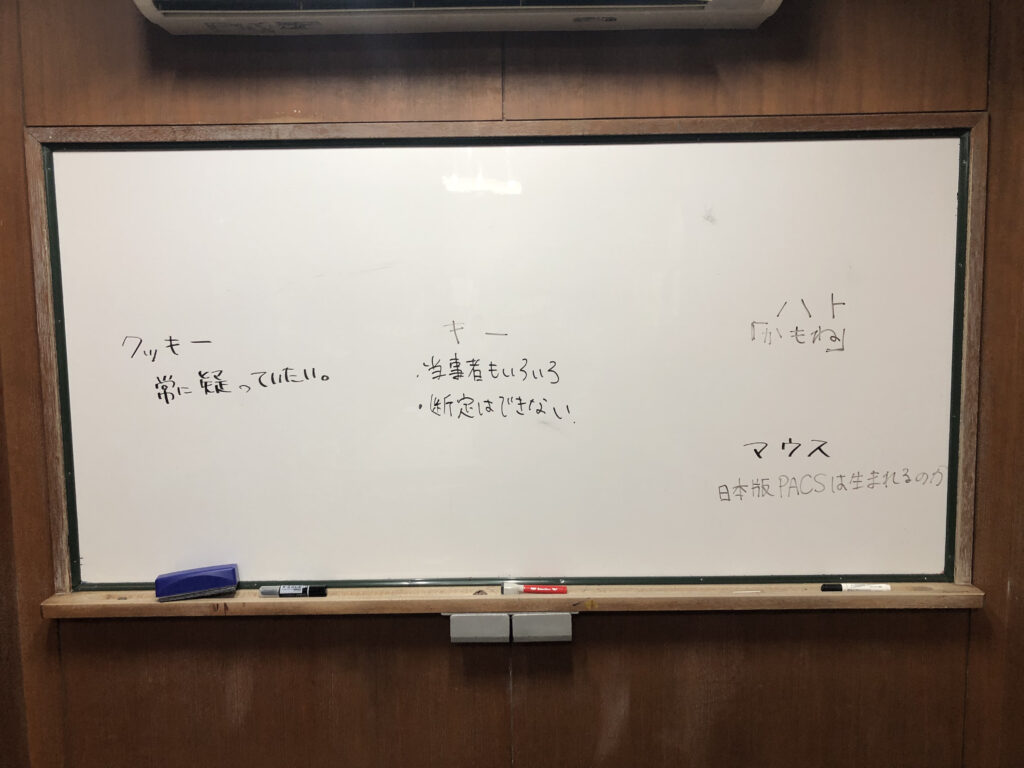
Furthermore, referring to systems such as PACS (France) and SAMBO (Sweden), discussions developed around how society positions cohabitation and de facto marriage, and whether institutionalization might be possible in Japan as well.
It was also suggested that younger generations may be less attached to marriage as a ritual for gaining recognition from those around them. Some participants felt that the option of not holding a wedding ceremony at all has expanded. On the other hand, examples were mentioned of uniquely coordinated weddings—such as ceremonies held in forests—that emphasize individuality. From this, the view was shared that, against a backdrop of diverse values, the ways weddings are conducted may be becoming increasingly layered and multifaceted.
Amid the many different expressions available, participants shared the importance of sometimes having the strength to make clear statements, while also continuing to think about what expressions best reflect the present era and current realities. The session became a time to confirm together the importance of pausing, considering differing opinions and positions, and recognizing the fear and risks involved in making definitive assertions.
Notes: Danshiro
References:
"Men as Lonely Beings" by Toshiaki Tachibanaki
Chapter 2: The History of Marriage and Family in Japan
Chapter 3: Transformations in the “Form of the Family” in Contemporary Society
Past posts
- Why the Trouble?
- Matrilineal Society, Instinct, and Gender
- Perspectives on Marriage in Japan
- Future References
- Gender Roles Considered from Article 24 of the Constitution
- Colonial Rule and Gender
- Military History and Gender
- Expanding the Range of Masculinity
- Body Image Through the Lens of Body History
- How History Shaped Our Ideas of Gender
- Gender Representation from the Perspective of Women’s History
- Exploring the Family of the Future through Family History
- Body, Feminism, and Porn
- Nation and Gender
- Choices in Labor, Sex Education, and Gender
- On Postmodern Families and Gender
- On Diversifying Families and Children's Rights
- Gender Roles in Parenting