Sunday, April 26, 2026
Participants: 5
21st Meeting of the De-Gender Role Association
" Living our contradictions"
In our 21st meeting, we exchanged perspectives using Mitsu Tanaka’s book, This Star is Not My Star, as our core text. By unpacking the historical background of the Woman Lib movement in Japan, we explored the possibilities of living while embracing our inherent contradictions just as they are.
Perspectives on the Woman Lib Movement
The meeting began with a retrospective on how the feminist movement shifted phases—moving from the "First-Wave Feminism" spearheaded by Raicho Hiratsuka to the "Second-Wave Feminism (Woman Lib)" led by figures like Mitsu Tanaka, who forcefully reclaimed and asserted their own embodiment and physicality.
To better grasp the atmosphere of the era, we also outlined the events surrounding the United Red Army, which unfolded concurrently with the Woman Lib movement. By sharing both the feverish enthusiasm and the dark shadows of that historical moment, we established a foundational context for our dialogue.
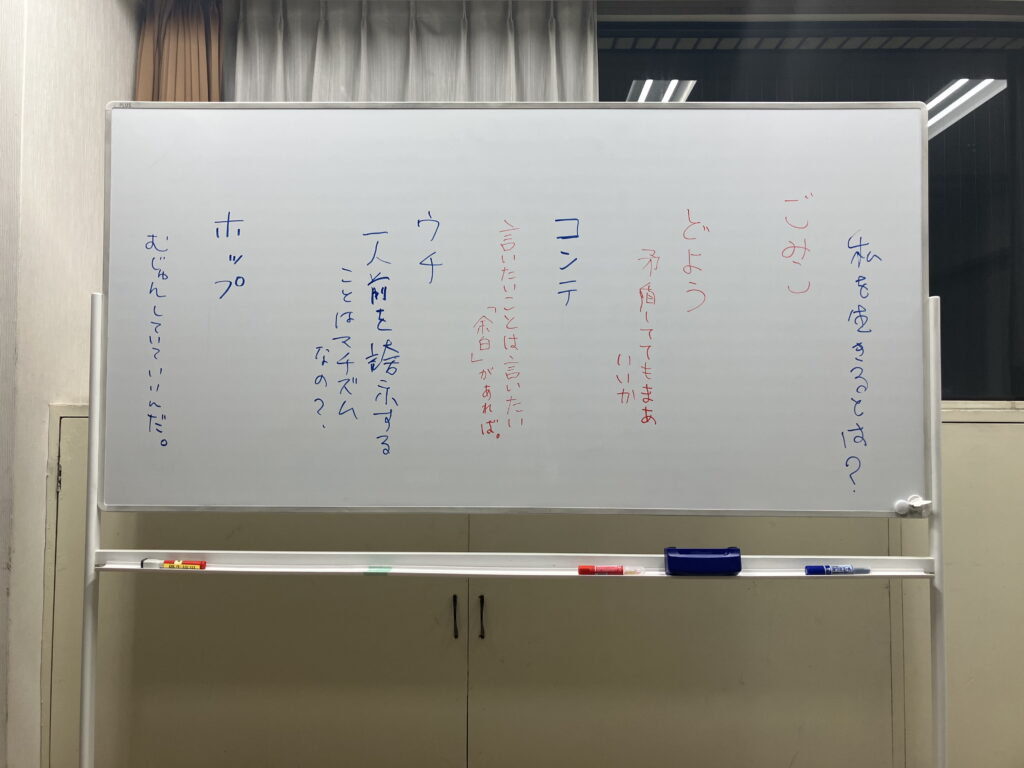
Rethinking "Full-Fledged Status" and Machismo
Our discussion turned to how a state’s pursuit of becoming a "full-fledged" nuclear power is often characterized as "machismo" (male chauvinism/dominance). Some participants expressed concern that framing the concept of being "full-fledged" (independent/adult) strictly as machismo might inadvertently reinforce biased, dominant gender values—values that define success solely through high earnings or winning competitions.
Just as legal systems and vocabulary are updated over time, opinions emerged suggesting we should find a more intrinsic term rather than relying on a gender-linked word like "machismo" when describing the tendency to exclude and show off power. Participants noted that true independence or being a "full-fledged" individual should mean being able to acknowledge one's vulnerability without hiding it, and being capable of sharing resources and mutually supporting each other rather than competing for them. This raised a central question: Do we need a new vocabulary to describe the urge to flaunt status and power without attaching it to a specific gender?
The Role of "Mama" versus the "Self"
We also discussed the phrase "#Mama is going to stop the Wars," which has recently gained traction on social media. While using the label "Mama" is an effective tactic to implicitly center the future of children and generate empathy, some participants felt an underlying discomfort. They noted that this framing causes the cry of the "individual self who is not a mother" to fall through the cracks.
ママという「役割」を盾にすることで平和を願うのではなく、ただの「私」として政治や社会と向き合いたい。ママという呼称が役割を押し付けられているように感じてしまうという意見も共有されました。
Age and Being True to Oneself
Mitsu Tanaka’s words possess a strength that fully accepts the self, contradictions and all. Reflecting on this, participants shared their own conflicted feelings—such as simultaneously experiencing joy at being perceived as younger than they are, while also appreciating the care shown when someone offers them a seat.
During the discussion, a male participant candidly remarked, "If I'm seen as younger, I actively choose not to correct people." Given that the Japanese language naturally alters speech styles based on age, it was suggested that the desire to be treated flatly and without filters might paradoxically drive the act of "hiding one's age." The conversation also touched upon the cultural custom where asking a man's age is socially permissible, yet asking a woman's age is frowned upon, noting how this dynamic remains tied to societal scrutiny regarding a woman's reproductive window.
Conversely, the conversation turned to the sense of loss experienced when someone who previously took pride in looking young realizes they no longer do. This was described not merely as a change in physical appearance, but as a bittersweet and jarring realization—as if they were being confronted solely with a "lack of freshness" rather than the recognition of their accumulated maturity as a human being.
To what extent can we let go of the obsession with "looking young" or the pressure to perform an expected, "desirable" vision of femininity? The participants shared a collective inquiry into the possibility of a new way of living: embracing these contradictions as a form of maturity, transcending the framework of age, and continuing to exist simply as "myself."
Seeking the "Margin" to Be Oneself
Tanaka famously captured an internal contradiction in her writing: "I don't want my butt to be grabbed, but I want to have the kind of butt that people want to grab." What kind of environment allows us to coexist with these ambivalent, gray-area feelings without forcing us to suppress them?
The dialogue connected the tragedy of the United Red Army—where the relentless pursuit of ideological "correctness" ultimately escalated into internal violence and lynchings—to our contemporary everyday lives. Even within the familiar sphere of the family, whether dealing with the tension of an in-law's house or navigating relationships with biological parents, we often unconsciously swallow our true feelings, a suppression that can manifest as physical ailments.
On the other hand, we debated whether an environment where anyone can say anything completely freely is the solution. In a space devoid of structure, the voices of those who hold systemic or interpersonal power inevitably dominate, creating new forms of subjugation. Participants concluded that what matters most is the ability to express one's agency on a foundation where a "mutual posture of listening" is fully established.
A powerful metaphor was shared during this segment: "To move a massive boulder together, everyone must shout in unison and perfectly align their timing. However, if you crush that boulder into small stones, each person can carry them at their own pace."
The enforced solidarity of trying to force everyone to march in lockstep may be precisely what gives rise to the "tyranny of correctness." The ultimate question left with the group was whether the flexible relationships we aim to build should resemble "carrying small stones"—finding a respectful distance that allows us to listen to one another's voices while maintaining our individual rhythms.
Notes: Danshiro
References:
"This Planet is not my Planet"
By Mitsu Tanaka
I: Living in the Post-Disaster Era
II: Gazing at Life
III: The Self Who is Here
Past posts
- "Parite and the Global Situation"
- Reflections on Parity
- Japanese social structure and gender
- Women's lib from the ground up
- Living our contradictions
- Future References
- A map of gender theorists
- Why the Trouble?
- Matrilineal Society, Instinct, and Gender
- Perspectives on Marriage in Japan
- Future References
- Gender Roles Considered from Article 24 of the Constitution
- Colonial Rule and Gender
- Military History and Gender
- Expanding the Range of Masculinity
- Body Image Through the Lens of Body History
- How History Shaped Our Ideas of Gender
- Gender Representation from the Perspective of Women’s History
- Exploring the Family of the Future through Family History
- Body, Feminism, and Porn
- Nation and Gender
- Choices in Labor, Sex Education, and Gender
- On Postmodern Families and Gender
- On Diversifying Families and Children's Rights
- Gender Roles in Parenting