August 30, 2026 (Sun)
Participants: 4
Degendering Roles Group — 25th Meeting
"Parite and the Global Situation"
Building on our last session, we used Promoting Gender Equality: Lessons from France and Japan’s Future as our core text. We read about initiatives aimed at increasing female parliamentarians in Pakistan, Bangladesh, South Korea, and Senegal, and exchanged views on how politics is perceived in Japan.
1. The Image of Politicians, and the Reality of "Running for Office and Money"
In our reading group, we had an honest conversation about how people view politicians as a career, as well as the real-world hurdles of running for office.
What Makes a Politician—and Feeling Out of Place
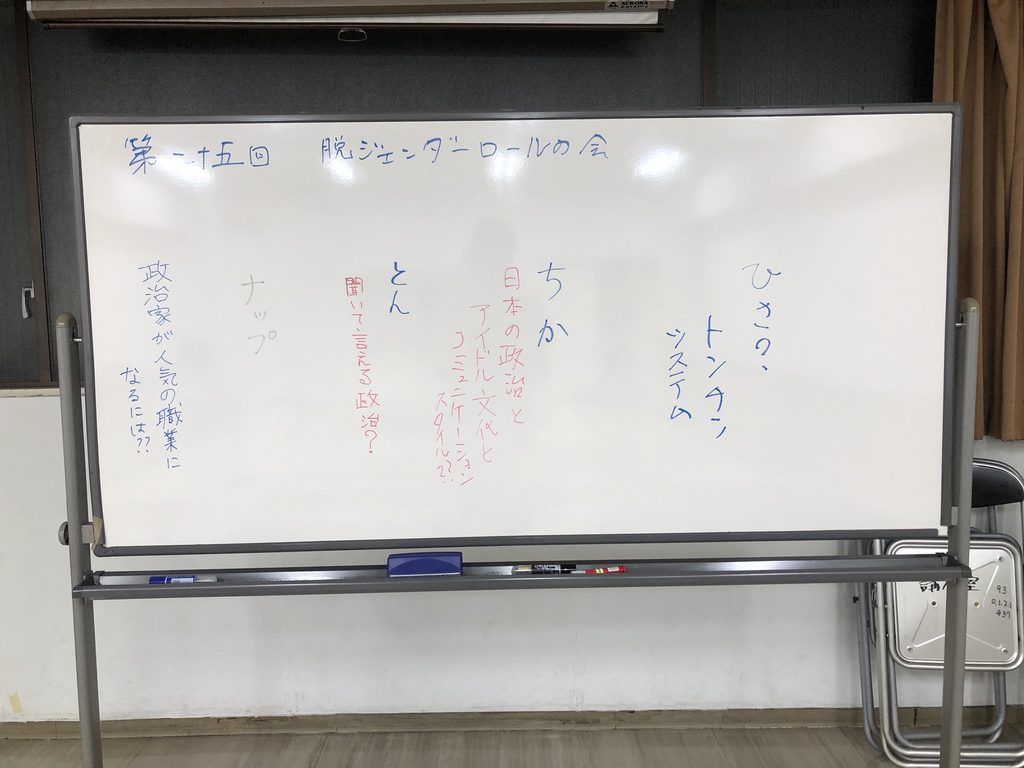
People expect politicians to speak their minds clearly and stand their ground when criticized. While some said, “That’s definitely not a job for my personality,” others noted, “If a woman wants to run, I really hope she can.” We also talked about the personal traits needed in politics, like being good at remembering faces and names.
We looked at examples like South Korea’s "zipper system," where candidate lists alternate between men and women to ensure female representation. Still, many felt that unless the overall culture and structure of politics change, women will continue to face a very tough environment even after getting elected.
We also discussed a study from India showing that "female politicians were more active in legislative work than men". Someone brought up a really sharp point: “If we just jump to ‘women are more diligent’ without looking at why, we risk creating a new gender stereotype”. It might not be that men are slacking off, but rather that women feel they have to prove themselves through high attendance and activity just to be taken seriously.
Political Education and Learning to "Set Our Own Rules"
Politics can easily lead to arguments, so people often treat it as a taboo topic in daily life. On the other hand, some mentioned they started talking about it more after the pandemic, showing that everyone’s turning point for feeling connected to politics is different.
That led into a discussion about how hard it is to imagine a primary school kid saying, “I want to be a politician!” This brought us to the topic of school education. Instead of just following rules made by adults, what if kids got to help set their own school rules? Experiencing firsthand that they can change the environment around them might be the very thing that helps them view politics in a more positive, familiar light.
The Cost of Running for Office and the Lure of Power
Given how uncertain it is whether you'll actually win, we questioned if running for office is realistically only an option for those with money to spare. In Pakistan, we saw cases where women from well-connected political families run for office. But we realized things aren't so different in Japan—if you need around 10 million yen just to cover campaign and public relations costs, it’s just as hard for people from low-income backgrounds to step forward.
This also raised a bigger question: “Is power addictive?” We talked about how politicians often start out wanting to fight poverty or help society, but over time, protecting their own lifestyle becomes the priority—leading to endless scandals over tax evasion and hidden funds. To counter this, someone shared a story about a person who intentionally keeps their feet on the ground—like sleeping on airport benches—so they don't get swept up or desensitized by power and luxury.
2. Going Beyond "Women's Rights," Korea's Conscription, and the Struggles Men Face
While increasing the number of female politicians is a key goal for gender equality, we looked deeper into what those goals really mean and who needs support.
「The Varied Reasons Behind Increasing Female Representation」
We’re pushing to get more women into politics so their voices can be heard, but we learned that not every female candidate is running specifically to fight for "women's rights."
In Pakistan, more women are voluntarily stepping up today to fight for their rights. In the past, however, running was often about family loyalty, and women were sometimes fielded just to fill numbers. On top of that, cultural practices like purdah (the tradition of women remaining behind screens or veiled) made it hard for a woman to give speeches on the street alone, leading to the creation of women-only polling stations. In places like India and Pakistan, reserved seats for women were originally created to ensure space for religious and social diversity, rather than just gender equality.
ルワンダ、キューバなどは女性議員比率が50%近く(あるいはそれ以上)に達していますが、ジェンダーギャップ指数とは必ずしも比例していません。ルワンダの女性活躍も「女性が自ら勝ち取ったものではない」という説もあり、単純に「女性議員の割合(数字)」だけがすべての答えになるわけではないと考えさせられました。
Mandatory Military Service in Korea and Missing Support for Men
We also agreed that women aren't the only ones who need support. In South Korea, for example, military conscription only applies to men, which some argue deprives them of early career opportunities. We also noted how little support exists for male victims of sexual violence, highlighting the need for a balanced approach that looks at the struggles of both men and women.
3. Community-Led Funds, Taboos Around Sex, and Japan's Cultural View of the Body
Frustration over how tax money is spent led to a broader conversation about daily taboos and cultural differences in how we view our bodies.
Seeing Where the Money Goes: Small-Scale Communities (Tontines)
Since it’s often hard to see where tax money goes, people were drawn to community-based micro-lending models run by local networks, especially among women. One example is the "tontine" system found in places like Pakistan, where people pool their money within a small community to fund local activities. Having full transparency over how their money is used felt like a real, practical way to make a difference.
Taboos Surrounding Sex」
One participant shared a memory from their student days during the Women's Liberation movement, when students debated "how women's bodies are treated." Moving from the issue of women's bodies being objectified, the talk turned to a everyday detail: "Why do pharmacies put sanitary products in opaque paper bags?" Some felt that hiding them in bags actually reinforces the idea that period products are something to be ashamed of. Someone also posed a simple question: "If a man buys condoms, they don't put them in a special bag, but would they do it for a woman?"
「Nudity in Japanese Culture vs. Physical Touch」
Looking at how political activism works abroad led us to think about Japan’s unique communication style. Japan has a rich culture of shared nudity—like at traditional festivals and onsen (hot springs)—yet everyday physical affection is far less common than in Western cultures. We wondered out loud, "Why does seeing a couple kiss in public stand out so much in Japan?" which led to a broader chat about our unique sense of personal space and physical touch.
We also discussed how Japan’s "idol culture" might be rooted in a "reading the room" (kūki wo yomu) mindset—one that values group harmony over standing out as an individual. While this quiet, attentive way of listening to others (keichō) doesn't always get international recognition, we felt it’s something to be proud of—a unique strength of Japanese culture, much like its cuisine.
Notes: Danshiro
References:
Promoting Gender Equality: Lessons from France and Japan’s Future — Beyond the 20th Anniversary of the Parity Law
Ed. Atsuko Fujitani and Tatsuro Niikawa
Part 3: Gender Equality in the Political Sphere Worldwide: A Comparative Perspective with the Parity Law
Chapter 1: Women's Political Participation in Pakistan
Chapter 2: Women's Political Participation in Bangladesh
Chapter 3: Women's Political Participation in South Korea
Chapter 4: Women's Political Participation in Senegal
Past posts
- "Parite and the Global Situation"
- Reflections on Parity
- Japanese social structure and gender
- Women's lib from the ground up
- Living our contradictions
- Future References
- A map of gender theorists
- Why the Trouble?
- Matrilineal Society, Instinct, and Gender
- Perspectives on Marriage in Japan
- Future References
- Gender Roles Considered from Article 24 of the Constitution
- Colonial Rule and Gender
- Military History and Gender
- Expanding the Range of Masculinity
- Body Image Through the Lens of Body History
- How History Shaped Our Ideas of Gender
- Gender Representation from the Perspective of Women’s History
- Exploring the Family of the Future through Family History
- Body, Feminism, and Porn
- Nation and Gender
- Choices in Labor, Sex Education, and Gender
- On Postmodern Families and Gender
- On Diversifying Families and Children's Rights
- Gender Roles in Parenting