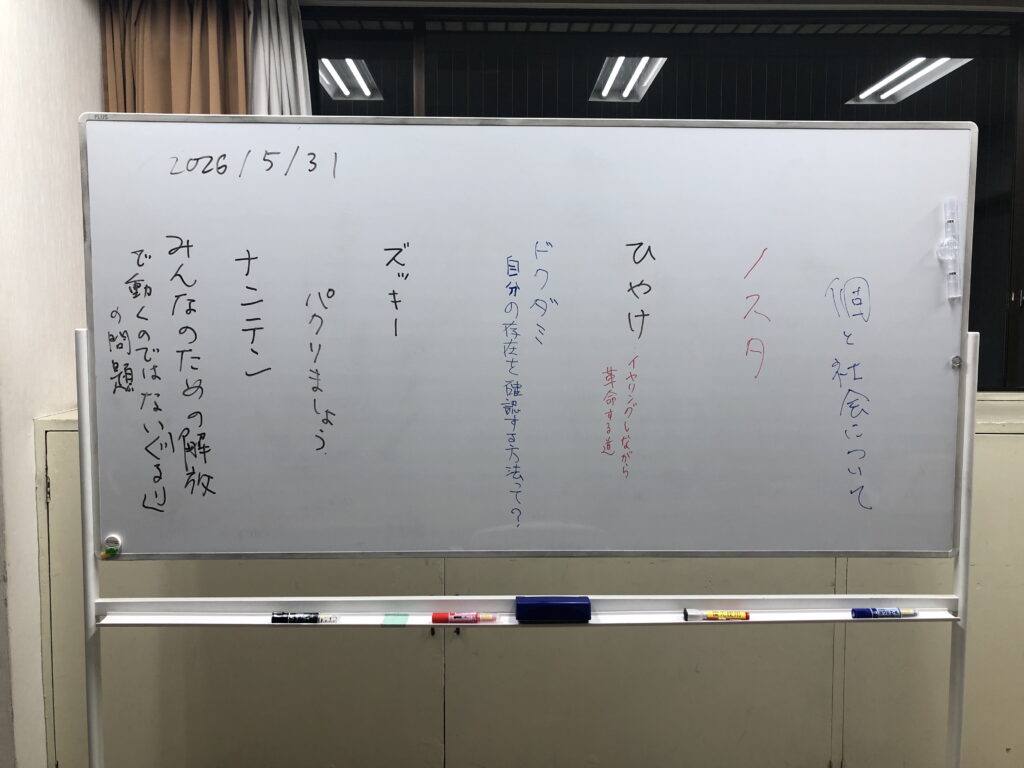
May 31, 2026
Participants: 5
22nd Meeting of the De-Gender Role Association
"Women's lib from the ground up"
In this roundtable session, we engaged in a dialogue based on Chapters 4 and 5 of Mitsu Tanaka’s book, This Planet Is Not My Planet (Kono Hoshi wa, Watashi no Hoshi janai), a pioneering figure who led Japan's women's liberation movement (Women's Lib).
Just as important as aiming for major societal transformation, Women's Lib values liberating oneself first and examining gender through the issues within one's own "gururi" (immediate surroundings). As usual, our discussion progressed from these everyday personal matters.
Memories of Tolerating Sexual Violence and Sexuality Education regarding Boundaries
Mitsu Tanaka, who experienced sexual violence in her childhood, was trapped for a long time inside her own narrative of being a "ruined woman" until she reached adulthood. However, she later realized that "it is the discriminating society that is in the wrong," which allowed her to gradually reclaim her own words.
Taking this journey as a starting point, the first half of the reading session involved participants sharing their own childhood experiences of sexual violence. Reflecting on the circumstances of the harm they faced during part-time jobs or lessons, each participant contemplated what the appropriate response should have been.
What resonated most during the discussion was the memory of tolerating the abuse—acting as if "nothing had happened" while the perpetrators behaved as though everything was normal. Many recalled being unable to leave the situation immediately or tell their parents. We also discussed how some parents, when confided in, might misinterpret it as a dream or pretend it never happened; however, Tanaka’s parents were not like that. Yet, even so, the trauma of the harm remains.
Furthermore, while discussing appropriate measures to take when experiencing sexual violence, the conversation turned to the boundaries of children's play. Participants questioned whether situations where boundaries become ambiguous—such as "playing doctor" as an extension of playing house—should be defined as sexual violence, and how parents should handle such situations as their children grow older.
Modern sexuality education has advanced compared to those days, now verbally conveying that "your body belongs to you" and teaching the importance of private zones starting from the age of three. The session became a time for all participants to reflect on how to build a foundational environment that prevents the trauma of sexual violence from turning into self-blame.
The Role of the "Good Wife" and the Power Balance at the Dinner Table
In the middle of the reading session, sparked by Mitsu Tanaka's account of men during the student movement era saying, "I want to marry a woman who doesn't participate in the movement," as well as a food-related anecdote between a couple in their 20s or 30s, we discussed the ideal image of a "wife" that still persists in altered forms today, and the gender roles within domestic life.
A woman called her partner asking, "Is it okay if we eat out tonight?" The man replied, "How about buying some pre-made side dishes instead?" and returned home. For some reason, however, the woman had cooked a meal and was waiting for him, and she suddenly burst into tears while they were eating together. To the man, this appeared to be "mysterious tears" with no apparent reason, but a deep-rooted power balance lurks beneath this situation.
The fact that she had to ask for permission ("Is it okay if we eat out?") indicates that the decision-making power regarding meals did not rest with her. It reflects the figure of a woman who is exhausted from fighting against the invisible pressure that she is the one responsible for preparing meals and that she must not cut corners. It was pointed out that even now, in the Reiwa era, a perilous consciousness of "becoming a traditional wife"—which internalizes fixed gender roles—deeply remains.
"Marriage blue" (pre-wedding blues), which causes instability before marriage, differs from "maternity blue" (baby blues) which is influenced by hormonal balances; instead, it stems from anxiety about the life ahead. For this reason, rather than dismissing it as mere emotional instability, it was discussed that couples need to constantly confirm each other's fundamental values in daily life and engage in continuous dialogue to resolve feelings of gender inequality and vague anxieties.
In addition, participants shared how the perception that women should handle home cooking remains strong despite most professional chefs being men, and how men are excessively praised by those around them just for making their own lunch boxes.
"Revolution with Earrings": Refusing to Sacrifice One's Desires
Next, the discussion deepened around Mitsu Tanaka's phrase from the book: "Instead of seeking equality on par with men and advancing by being recognized from above, there could have been a path to carry out a revolution while wearing earrings." We also examined the book's expression "women who go to the river" to describe the painful struggles of women who try to be independent but end up drifting along with society or men, sacrificing themselves.
In past student movements or the male-dominated sports world, women were implicitly required to "assimilate with men" (the determination to discard feminine adornments) when entering those spaces. However, Tanaka points out that a method that eliminates the color of life or fashion and forces self-sacrifice leads to a dangerous mentality akin to the Kamikaze tokkotai (suicide squads). While accessories for men have increased nowadays, it was suggested that "earrings" back then strongly symbolized fighting without surrendering one's femininity or inherent individuality.
Following that thread, a participant brought up examples from the sports world, such as when Kimiko Date or Maria Sharapova stood on the court wearing necklaces or earrings, which was treated sensationally as bringing "decorations" into a male-dominated space governed solely by winning and losing. That very attitude embodied the stance of "revolution while wearing earrings"—refusing to discard oneself to assimilate with men, and instead seizing a life without sacrificing one's own desires. Living while cherishing the daily life and body that are continuously linked to one's immediate surroundings was precisely the horizon that Women's Lib aimed for.
From the participants, voices emerged expressing that while liberating society as a whole is important, they want to address gender starting from their own "gururi" (immediate surroundings) in order to liberate themselves first. They also spoke about the guilt of stepping out of the maternal role to go out drinking on weeknights, and the self-sacrifice driven by the ideal image of a mother. Furthermore, watching a video of Mitsu Tanaka humorously singing a song called "Let's rip off (men)," some shared the impression that rather than exhausting oneself by fighting head-on against male society, that level of frank distance and humor is wonderful. It made us reflect that what these thoughts have in common is precisely the practice of a "revolution wearing earrings," living while treasuring one's own desires.
Honest Intentions Beyond "Fluffy Words"
At the end of the reading session, the conflict between Hiromi Ito and Mitsu Tanaka through their letters, as depicted in Chapter 5 of the book, became the topic of conversation. Triggered by the skillfulness of their exchange of letters—where they communicated emotions directly and drew something out of each other—and their raw human interaction, the discussion expanded to the nature of language in modern society and dialogue within families.
An example was shared that in recent schools and society, language is being managed with slogans like, "Let's not use prickly words (togetoge-kotoba); let's use fluffy words (fufuwa-kotoba)." However, doubts and objections arose among the participants, noting that "when the managing side cleans up and regulates language for their own convenience to eliminate conflicts, it ends up suppressing even the emotional fluctuations of human beings." What matters is having a place where people can engage in dialogue with peace of mind without fearing that the relationship will break. It seems that through interactions like those between the two women, refined words of honest intention are drawn out.
Even in family or couples' meetings, some participants mentioned that they try to pick up the unspoken claims of children, or when a couple's timing for a decision diverges during a major purchase, they wait for their paces to align while seeking an honest dialogue.
From this discussion on how to face other people's honest intentions, the conversation expanded to the question of how to confirm one's own existence and true feelings. Some people feel a sense of belonging by exchanging greetings through community development (machi-zukuri), while others directly confirm their existence by using their bodies through weight training. Opinions were shared that moments spent listening closely to the voice of one's own body—such as taking time on a weeknight to step out of the role of a mother to go out drinking, or the time spent caring for one's own skin by applying moisturizing cream—serve as a vital period to face one's true, honest self.
Notes: Danshiro
References:
"This Planet is not my Planet"
By Mitsu Tanaka
IV. Dialogues with Women
V. Someday, Somewhere Again
Past posts
- "Parite and the Global Situation"
- Reflections on Parity
- Japanese social structure and gender
- Women's lib from the ground up
- Living our contradictions
- Future References
- A map of gender theorists
- Why the Trouble?
- Matrilineal Society, Instinct, and Gender
- Perspectives on Marriage in Japan
- Future References
- Gender Roles Considered from Article 24 of the Constitution
- Colonial Rule and Gender
- Military History and Gender
- Expanding the Range of Masculinity
- Body Image Through the Lens of Body History
- How History Shaped Our Ideas of Gender
- Gender Representation from the Perspective of Women’s History
- Exploring the Family of the Future through Family History
- Body, Feminism, and Porn
- Nation and Gender
- Choices in Labor, Sex Education, and Gender
- On Postmodern Families and Gender
- On Diversifying Families and Children's Rights
- Gender Roles in Parenting